
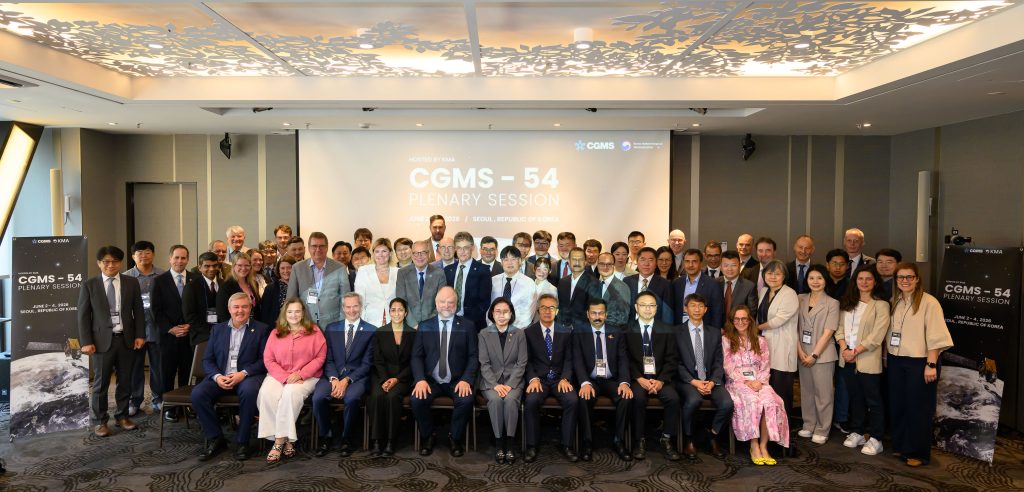
The CGMS-54 plenary meeting, hosted by KMA in Seoul on 2-4 June 2026, provided an excellent setting for productive discussions among CGMS Members. Agenda and publications are available here.
A key outcome of the meeting was the recognition of artificial intelligence and machine learning (AI/ML) as a strategic priority for CGMS. Members agreed to establish an expert team to support the development of a joint WMO-CGMS workshop on AI from 2027 onwards, aimed at identifying clear guidance and coordination mechanisms across the wide range of communities involved in meteorology and Earth Observation. In parallel, a dedicated task team will be created to assess the impact of AI from an end-to-end operational perspective, ensuring that emerging technologies can be effectively integrated into future observing and forecasting systems.
The plenary also highlighted the critical importance of protecting radio frequency bands used for meteorological observations. Members expressed growing concern over increasing levels of radio frequency interference and the need to safeguard the meteorological spectrum from the impacts of mega-constellations and future telecommunications allocations. Reflecting this priority, the plenary formally endorsed the Data Collection System Radio Frequency Interference Best Practices document.
Strengthening the connection between scientific research and operational applications was another major theme of the meeting. Members approved the establishment of the International Earth Surface Working Group as a permanent CGMS International Science Working Group. The group will help bridge science and operations within the CGMS framework, with a particular emphasis on supporting Numerical Weather Prediction applications.
The plenary also expressed strong support for the creation of an Operational Fire Detection Task Team, reflecting increasing operational demand for timely and reliable wildfire monitoring capabilities. In addition, Members endorsed further work to assess the impact and potential benefits of emerging three-dimensional wind products for operational meteorology.
CGMS Members reaffirmed their commitment to the operationalisation of greenhouse gas (GHG) observations. The plenary endorsed operational GHG product requirements for future Monitoring and Verification Support systems based on global space-based GHG mapping missions. As a next step, CGMS will work with partners to identify equivalent operational requirements for the ground-based GHG reference data community, helping to ensure consistency and interoperability across the observing system.
Responding to ongoing initiatives led by the World Meteorological Organization (WMO), the plenary formally endorsed a coordinated CGMS position on the update of the WIGOS Vision 2040, together with a statement to be delivered by the Head of the CGMS Secretariat to the upcoming 80th WMO Executive Council session (EC-80). CGMS and WMO Secretariats will also collaborate on the preparation of a paper for INFCOM-4 addressing the proposed update of the Manual on the WIGOS.
Members reiterated their support for the WMO Early Warnings for All (EW4All) initiative and for a range of regional activities aimed at closing capacity gaps, including the CGMS-WMO Virtual Laboratory (VLab) programme. Continued support was also requested for cryosphere and polar observations, recognising their growing importance for climate monitoring and prediction.
The meeting further emphasised the importance of sustained Space Weather monitoring capabilities and acknowledged the increasing role of commercial data providers within the Earth Observation landscape. In coordination with WMO, CGMS has begun exploring approaches for engaging more effectively with the private sector while maintaining the principles of data accessibility, reliability and long-term continuity.
Looking ahead, preparations are already underway for CGMS-55 in 2027. The 9th CGMS WGIII Risk Assessment will take place virtually on 24-26 February 2027 and will address, among other topics, the potential gap in Earth radiation budget observations and the possible loss of low-inclination radio occultation observations in the coming decade, following the end of life of the COSMIC-2 mission.
The CGMS-55 Working Group meetings will be hosted by EUMETSAT from 19-23 April 2027, while the CGMS-55 plenary session will be hosted by the India Meteorological Department on 15-17 June 2027. In the period leading up to the next plenary, CGMS working groups will continue their activities through a series of intersessional virtual meetings to maintain momentum on key priorities and deliverables.